



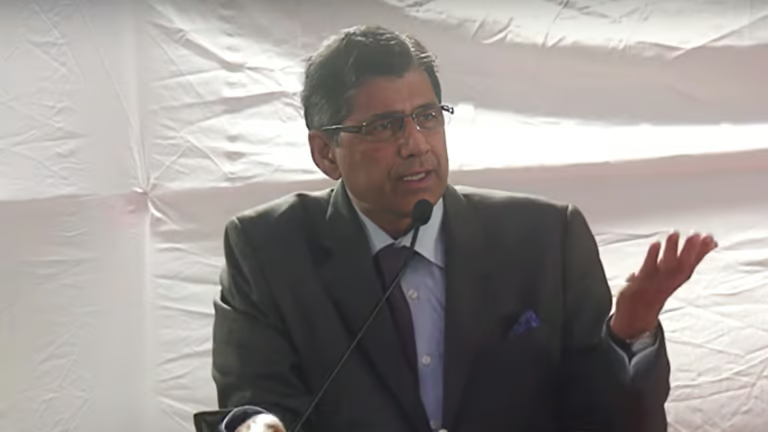
The senior lawyer was speaking at the Justice KT Desai Memorial Lecture 2023 on the topic Anti-Defection and Constitutional Morality – the need to replace the Tenth Schedule.
Senior Advocate Arvind Datar on Monday suggested that the Speaker of a legislative assembly or the parliament should no longer be the authority to decide on petitions for disqualification of Members of Parliament and Members of Legislative Assembly (MPs/ MLAs) under the Tenth Schedule of the Constitution.
Instead, High Courts should be tasked with hearing and deciding such petitions, Datar suggested.
“Today under Article 329, in Madras, there is a permanent judge who decides election petitions so that the court is only occupied with election petitions. I would suggest, if there is a question as to whether the person has incurred disqualification under the Tenth Schedule, we can have an Article 329A (as a new provision in the Constitution) where decision on disqualification is decided (by High Court judges).”
Datar’s speech was part of the Justice KT Desai Memorial Lecture Series of 2023 on the topic Anti-Defection and Constitutional Morality – The Need to Replace the Tenth Schedule.
In his address, Datar said that after 1985, it was evident that the anti-defection law in the Tenth Schedule was not a solution for defection of lawmakers.
On analysing anti-defection case law, he found that the entire controversy was centered on the second paragraph of the Tenth Schedule, which did not specify the role of the Speaker while hearing cases arising from political party splits.
Datar referred to judgments to point out that theoretically, a Speaker was expected to be impartial. However, by nature, the Speaker is also a member of a ruling party and empirically found to be partial.
“Most important difficulty in all the judgments I have studied is that the decision is not taken on time and the decision, if taken, is completely partial. The framers of the Constitution said these are all eminent constitutional offices and they will do their duty in an expeditious manner, but it has not happened at all,” he said.
In view of this, Datar suggested that the Speaker should no longer be the authority to decide on disqualification applications.
“It is not possible to expect, and I don’t blame the Speaker. He belongs to the ruling party. History, empirical data has shown there is not a single instance of a Speaker voting against his party, at least in my record and reading,” Datar pointed out.
He also emphasised that the distinction drawn by the Supreme Court between a political party and a legislative party while deciding on petitions arising from the split of the Shiv Sena in Maharashtra was important.
Datar highlighted that the ruling of the Supreme Court Constitution Bench completely removed any confusion between the two phrases.
“What the Supreme Court clarified in the Subhash Desai case is that the power to appoint a leader and whip of the party is with the main political party and not the legislative party. That confusion has been completely sorted out,” Datar observed.
Datar elaborated that the Supreme Court differentiated between a political party, the Speaker of the State Legislative Assembly and the Election Commission.
The Constitution Bench accepted the argument made by the Election Commission of India that there being a difference between a dispute over the symbol of a party and the disqualification of the party’s members.
“The question arose, if there is a defection, and some members say we are the party, the defecting group says we are the actual party. The Election Commission argued that once a person is part of the Assembly or Parliament, then the entire person qua his jurisdiction lies with the Speaker. As far as the original party is considered, that is the jurisdiction of the Election Commission. If it is a disqualification other than (under) the Tenth Schedule, then the procedure to be followed is to the Election Commission and then the Governor. If it is a disqualification under the Tenth Schedule, then the only person authorised is the Speaker as it stands,” Datar said.
He pointed out that the Constitution Bench held that the Election Commission need not wait for the decision of the assembly on disqualification before acting on disputes other than those related to the Tenth Schedule of the Constitution.
An important aspect that the Supreme Court clarified was that a political party had power to appoint the Whip of the party.
“One very important thing and useful thing that the Supreme Court has clarified in the Subhash Desai case is that the power to appoint the leader in the party and whip of the party is with the main political party and not with the legislative party. So that confusion is completely sorted out”, Datar said.
Datar also advised that the party whip system needs to be used with caution.
“There is a difference between genuine dissent and defection. I would say, unless it is a no-confidence motion, unless it is a money bill, unless it is a bill which is going to implement the party’s manifesto, any other difference of opinion should not be considered as defection,” he said.
Finally, the senior lawyer recommended additions to the Tenth Schedule to codify and define ‘voluntarily giving up membership.’
“Voluntarily giving up need not necessarily mean you have given up membership and that you are no longer on the register of the party. Your conduct can also show that even if you remain a member of the party, you have voluntarily given up membership if you give television interviews for opposition parties, or debates or lectures in support of the opposition,” Datar explained.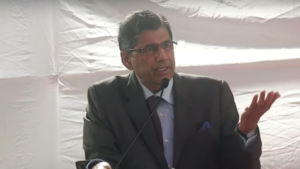



+ There are no comments
Add yours