









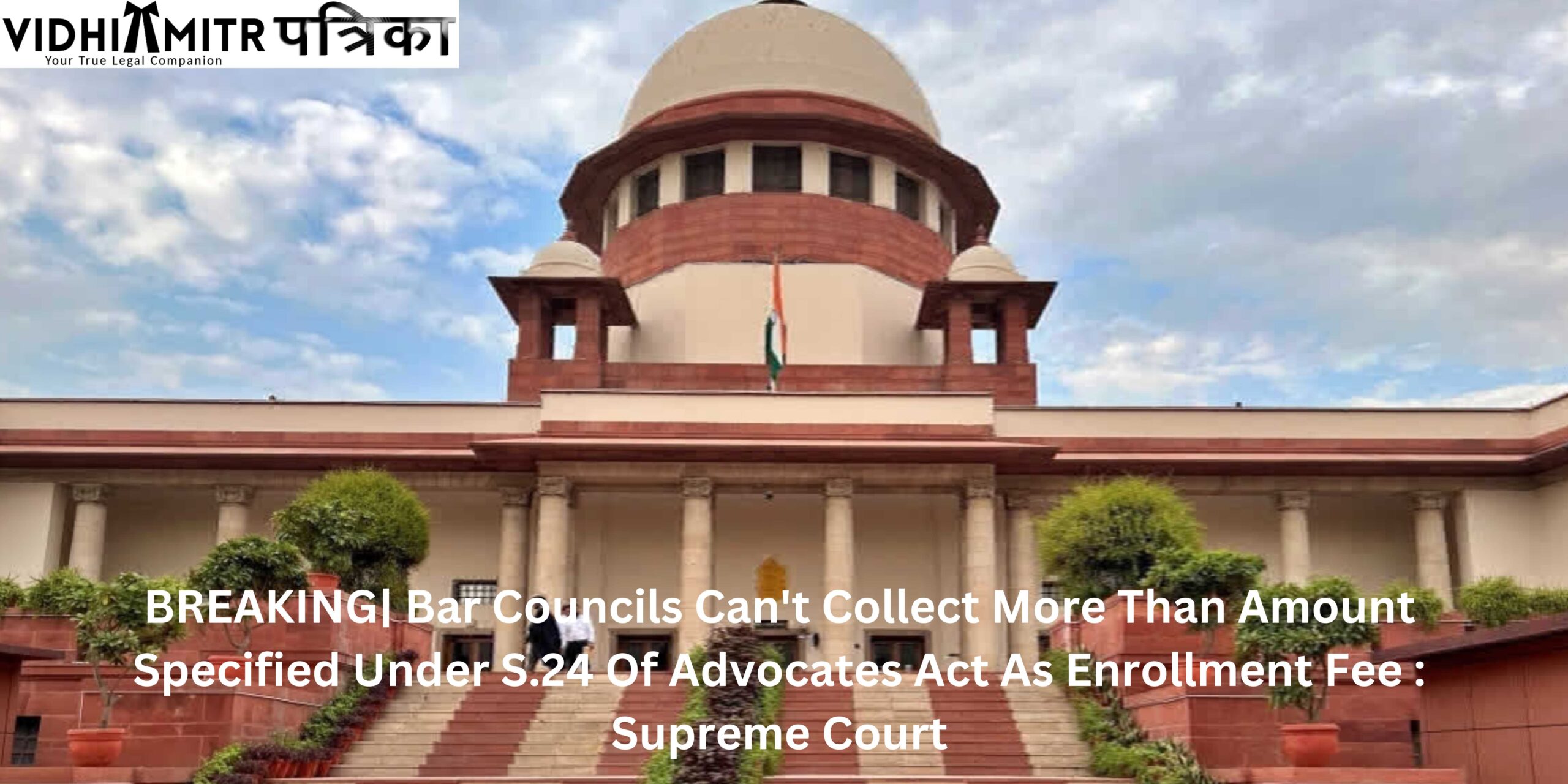
The supreme Court on Tuesday (July 30) held that the enrolment expense can’t exceed Rs.750 for advocates having a place with the overall classification and Rs.125 for advocates having a place with SC/ST classifications.
The Court completely held that State Bar councils can’t charge any sum over the above-indicated sums under the head of “random expense”, “stamp duty” or different charges. The State Bar Gatherings and the Bar Council of India can’t charge any add up to concede advocates to the roll over the sum determined under under 24(1)(f) of the advocates Act.
The advocates act of 1961 under S. 24(1)(f) recommends the enrollment charge payable to the State Bar council as Rs. 600/ – and Rs 150/ – towards the Bar Council of India for advocates having a place with the overall class. For advocates having a place with SC/ST classes, the sums are Rs.100 and Rs.25 respectively. An detailed graph on the state-wise expense chargeable by various bar council can be accessed here. In some States, the enrolment expense goes to the extent of Rs.40,000.
The Court held that since the Parliament has indicated the enrollment expense, the Bar councils can’t abuse something similar. Section 24(1)(f), being a monetary administrative arrangement, must be understood rigorously, and since the Parliament has specified the sum in the activity of its sovereign power, the State Bar councils or the Bar council of India, being delegatees under the resolution, can’t modify the financial strategy set somewhere near the Parliament.
The judgment authored by chief justice of India DY Chandrachud expressed that charging over the top expenses as a pre-condition for enrolment makes obstructions, particularly for those having a place with the underestimated segments, to pursue their profession. Since the competitors have little organization at the hour of enrolment, they are forced to satisfy the extravagant requests made by the Bar councils, the Court noted.












+ There are no comments
Add yours