










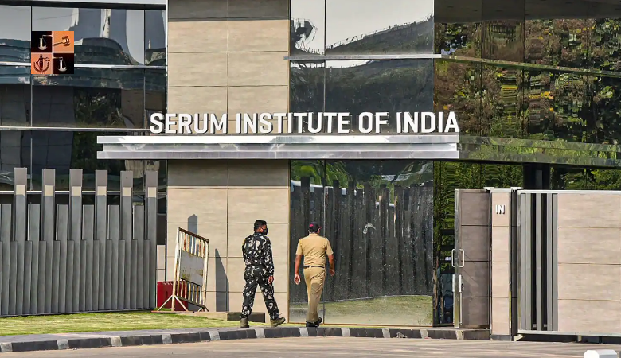
The Bombay High Court recently rejected a petition filed by the Serum Institute of India (SII) challenging amendments introduced in 2015 to the Finance Act that inserted sub-clause (xviii) to Section 2(24), which defines taxable “income”. [Serum Institute of India Private Limited v. Union of India & Ors.]
A division bench of Justices KR Shriram and Neela Gokhale upheld the validity of the amendment on December 4, while opining that courts should not interfere in matters of economic policy.
“Matters of economic policy should be best left to the wisdom of the legislature. In the context of a changed economic scenario, the expertise of the people dealing with the subject should not be lightly interfered with. While dealing with economic legislation, this court would interfere only in those few cases where the view reflected in the legislation is not possible to be taken at all. The case of petitioner certainly does not fall within this exception,” the Court said.
The amended provision, which came into effect in 2016, stated that subsidies, grants, incentives, waivers, concessions, reimbursements etc. provided by the Central or State governments would be included within the taxable income of an assessee.
The Court did not find anything to show that this amendment was irrational and dismissed SII’s plea.
“We are unable to find or even assume that what the legislature has done for inserting the impugned sub-clause is irrational. There is no room for any doubt. There is nothing to even question the constitutionality and in our view, the petitioner has not been able to demonstrate a clear transgression of constitutional principles” the Court said.
Serum Institute had earlier applied to avail incentives under the ‘Package Scheme of Incentives of 2013’ issued by the State of Maharashtra which included stamp duty concessions, exemption from electricity duty and VAT/CST/SGST subsidy.
After the Finance Act was amended to include such incentives within the fold of taxable income, the vaccine manufacturer challenged the amendment on the ground that sub-clause (xviii) to Section (24) had an unintended retrospective application. This provision did not exist when the Maharashtra government’s 2013 scheme was introduced, SII pointed out.
SII also argued that by taxing incentives, the Central government was indirectly taxing the revenue of the State, which was impermissible under the Constitution.
The SII further highlighted that under the amended Finance Act, all incentives, given in whichever form or for whatever purpose by the government, were to be treated as income irrespective of whether the same was a capital receipt or a revenue receipt.
Earlier, capital receipts were not taxable, SII pointed out. Capital subsidy has been held to be non-taxable by various courts, including the Supreme Court, SII added. The taxation of capital receipts was also Constitutionally impermissible, it was contended.
The Central government countered by arguing that the parliament has exclusive powers to make laws concerning any matters enumerated in List 1 of the Seventh Schedule of the Constitution including laws to tax income.
It also urged the Court to note that it must defer to legislative judgment in matters relating to social and economic policies and must not interfere unless the exercise of legislative judgment appears to be palpably arbitrary.
The Court found force in the Central government’s arguments and opined that the domain of economic and fiscal policy formulation is primarily vested in the legislature and the executive.
“The judiciary’s role is limited to ensuring conformity with the Constitution without delving into the policy merits. Overturning fiscal statutes could lead to economic chaos and undermine the authority of the legislative body. Therefore, Courts must balance the necessity to uphold constitutional mandates with the practical implications of interfering with legislative judgments in fiscal matters. The courts have only the power to destroy, not to reconstruct”, the Court said before dismissing SII’s challenge.
 t.
t.












+ There are no comments
Add yours